Congratulations to our 2026 Poster Contest Winners!
Poster Categories:
Best Poster Aesthetic:
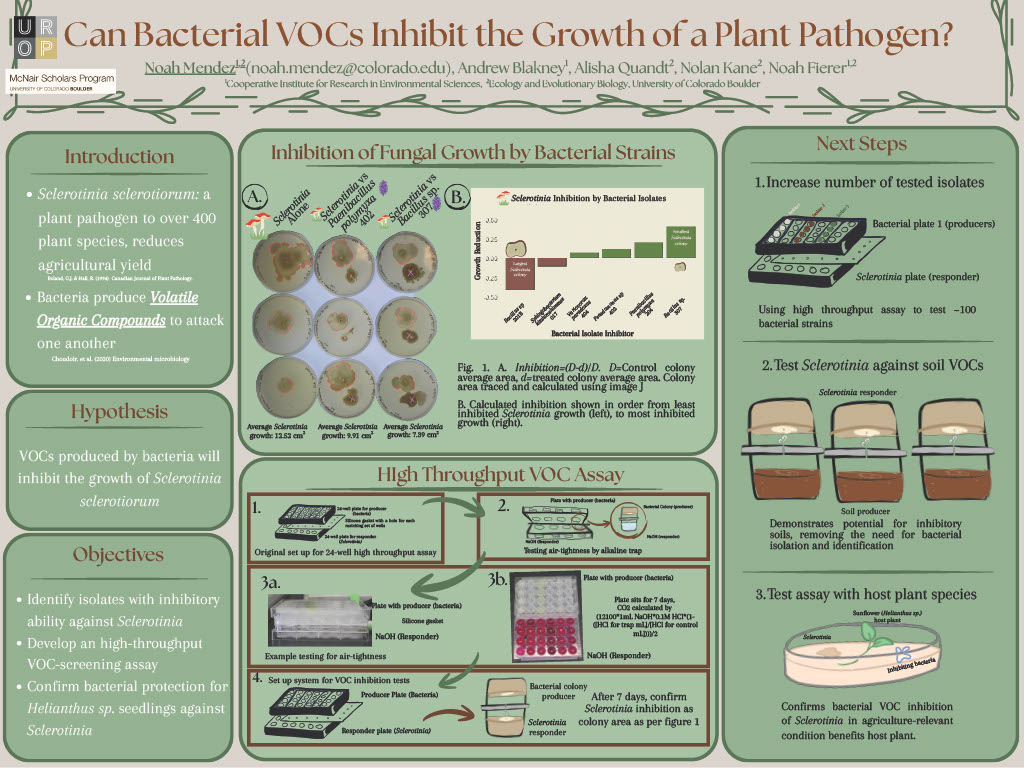
Noah Mendez, Andrew Blakney, Noah Fierer
Can Bacterial VOCs Inihibit the Growth of a Plant Pathogen?

"When designing my poster, the first thing I care about is the readability of the font and colors. If my poster is gorgeous but impossible to read, I haven't done my job at communicating my science. Likewise, my color palette often reflects my research. In this case, I used brown and green, showing that the microbes that I am working with come from soil and that my research also has a background or adjacency to studying plants. I also care very much about the color palette straining a reader's eyes. My poster had a pretty standard format, from intro to discussion, which flows well for Western readers, left to right, top to bottom, but I have played with vertical posters or removing sections when they aren't needed. Besides that, having a little understanding of the way things are visually appealing AND interesting to the human brain makes a poster stand out. Things I think about with an art background are that things being in odd numbers or squares are most satisfying to the human eye, offsetting things diagonally can both reduce space used and creates visual interest, and too much busy-ness (either visually or in text) is going to confuse one's audience. Lastly, always have fresh eyes on it, both one's own after rest and from other people who care about the message."
Most Creative Methods:
Rick Saltus, Manoj Nair, Nir Boneh, Holly McCrory, Jesse Varner, Rakesh Kumar
MagMapper! Citizen Science for Orphan Well Detection
"The MagMapper project is very much a team effort - the project was instigated by Manoj Nair based on discussions at a professional meeting with members of the DoE orphan well program. DoE was familiar with their citizen science "CrowdMag" app and asked Manoj if it could be adapted to the task of confirming suspected orphan well locations. Our talented programmer/developer Nir Boneh developed CrowdMag and is the developer for MagMapper as well. Rick provided some help with designing the initial user interface for the app as well as the logic for the data inversion and visualization. The project is a natural evolution of the citizen science applications of smartphone magnetometers."

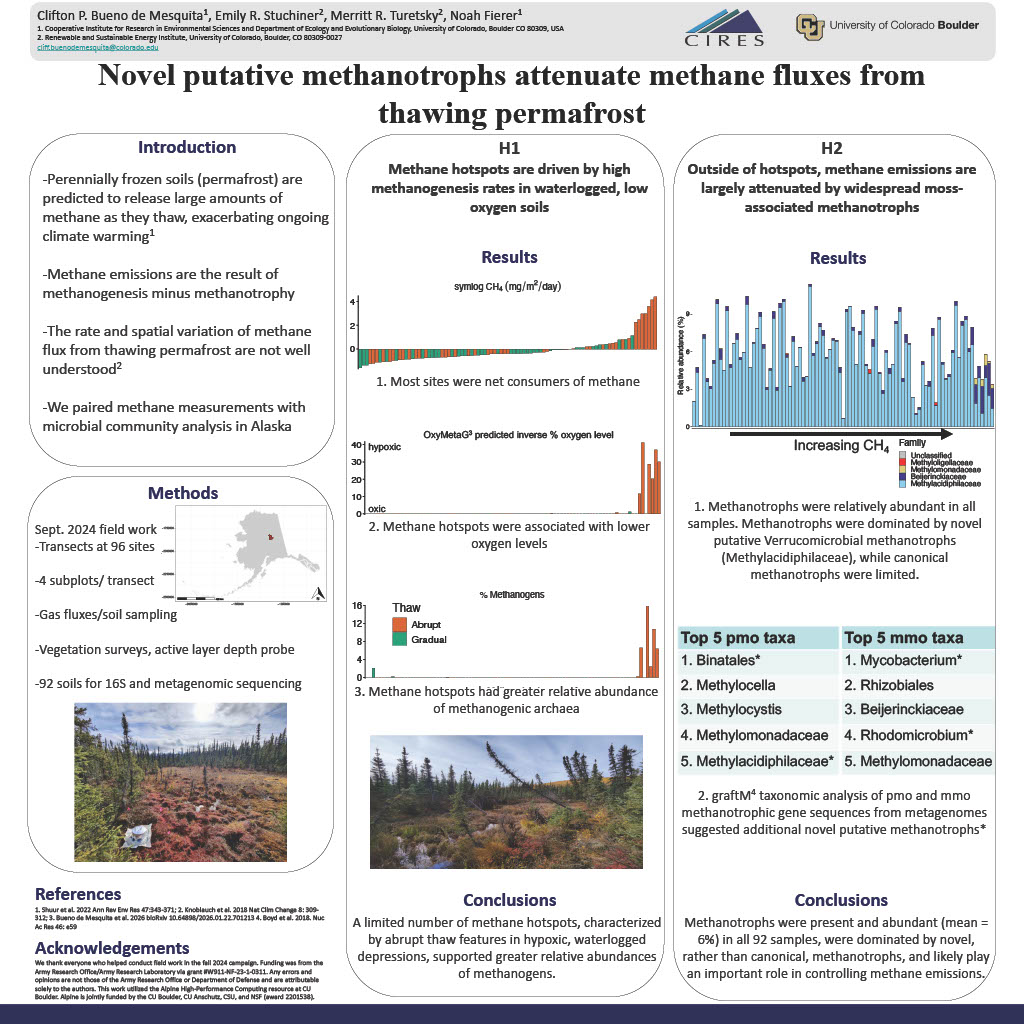
Clifton Bueno de Mesquita, Emily R. Stuchiner, Merritt R. Turetsky, Noah Fierer
Novel putative methanotrophs attenuate methane fluxes from thawing permafrost

"For the methods section, I made sure to include a couple photos of Alaska where we did the field work. I think people liked seeing and hearing about the “drunken forests” there where the permafrost thaws abruptly and the ground collapses and the trees tip. I think they also liked hearing about how we bushwhacked around the Fairbanks area sampling, including trudging through bogs etc."
Best Poster Title:
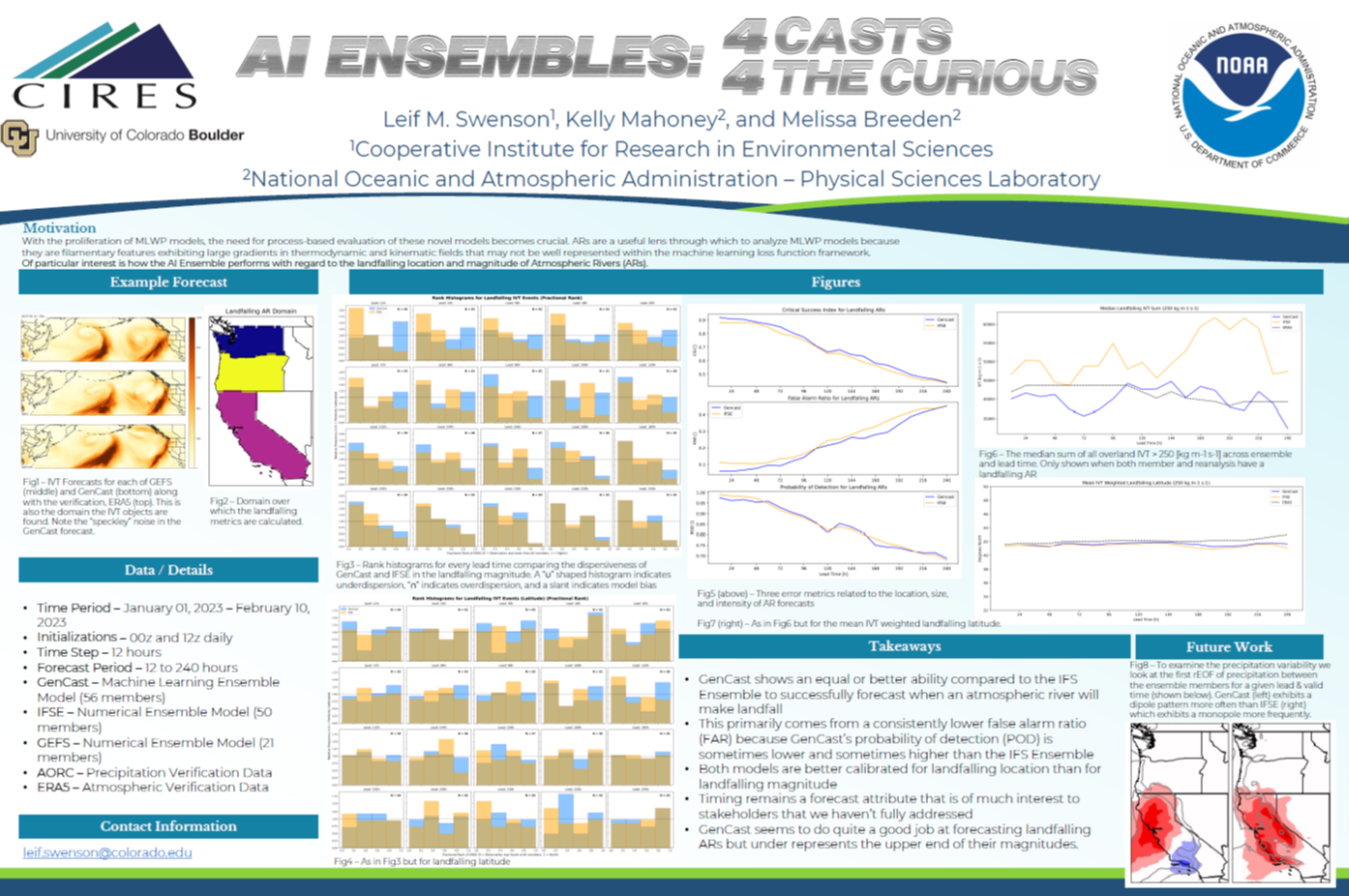
Leif Swenson, Kelly Mahoney, Melissa Breeden
AI Ensembles: 4 Casts 4 The Curious
"I wanted to use a pun as an enticing way to get folks to stop and engage with my poster. I'm thrilled that the "2 Fast 2 Furious" wordplay and rhyme scheme was enjoyed by so many."
Most Adventurous:
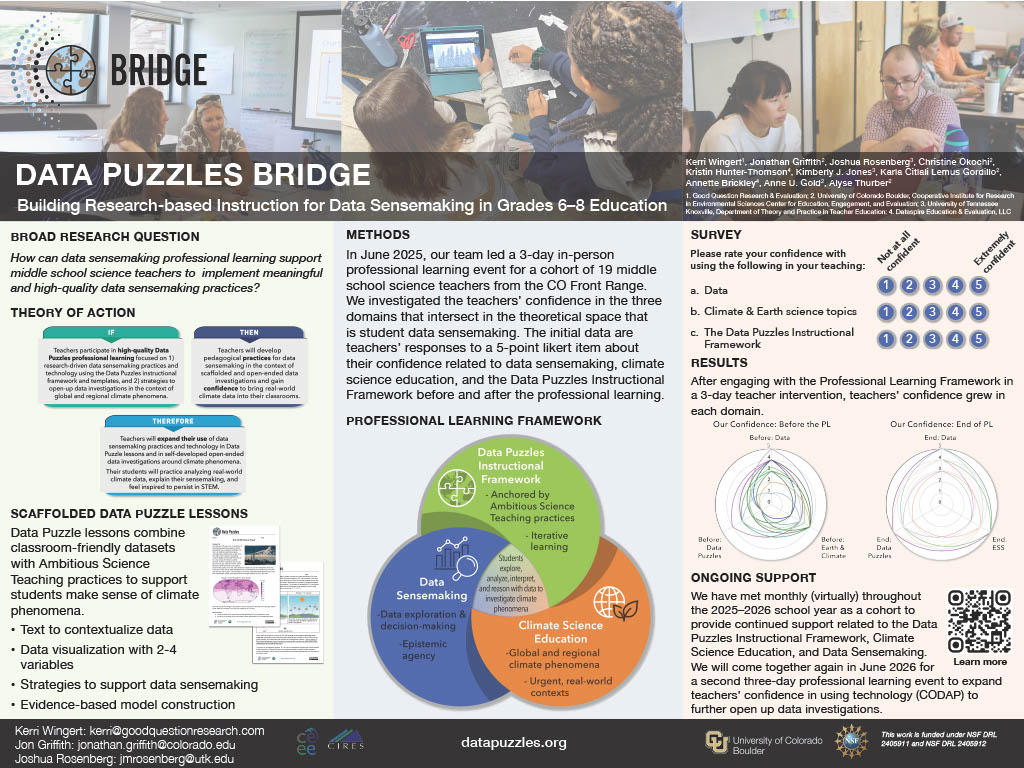
Jon Griffith, Kerri Wingert, Ami Nacu-Schmidt, Christine Okochi, Bridget Walsh, Abby McConnell
DATA PUZZLES BRIDGE Building Research-based Instruction for Data Sensemaking in Grades 6-8 Education

"For years, the CIRES CEEE team has collaborated with CIRES scientists to develop and train teachers to use Data Puzzle resources, resources that combine classroom-friendly data with innovative instructional practices to support learners make sense of climate-related phenomena(e.g., Arctic amplification). However, it's not until recently that these resources, or the related trainings, have been researched. Our poster described the adventurous and innovative ways in which we engaged a cohort of 19 middle school science teachers from the CO Front Range in a year-long professional learning community (PLC). Anchored by Data Puzzles resources, the PLC aimed to build teacher confidence in the following domains: data sensemaking, instructional practices, and climate understandings. Our results show that teacher confidence in each domain grew significantly following year 1 of this PLC. We're excited to share that we will continue to work with this same group of teachers for a second year of trainings that will focus on using an NSF-funded tool called CODAP to open-up data investigations!
Please don't hesitate to reach out to learn more about this project or to inquire about collaborating on a future Data Puzzles resource!"
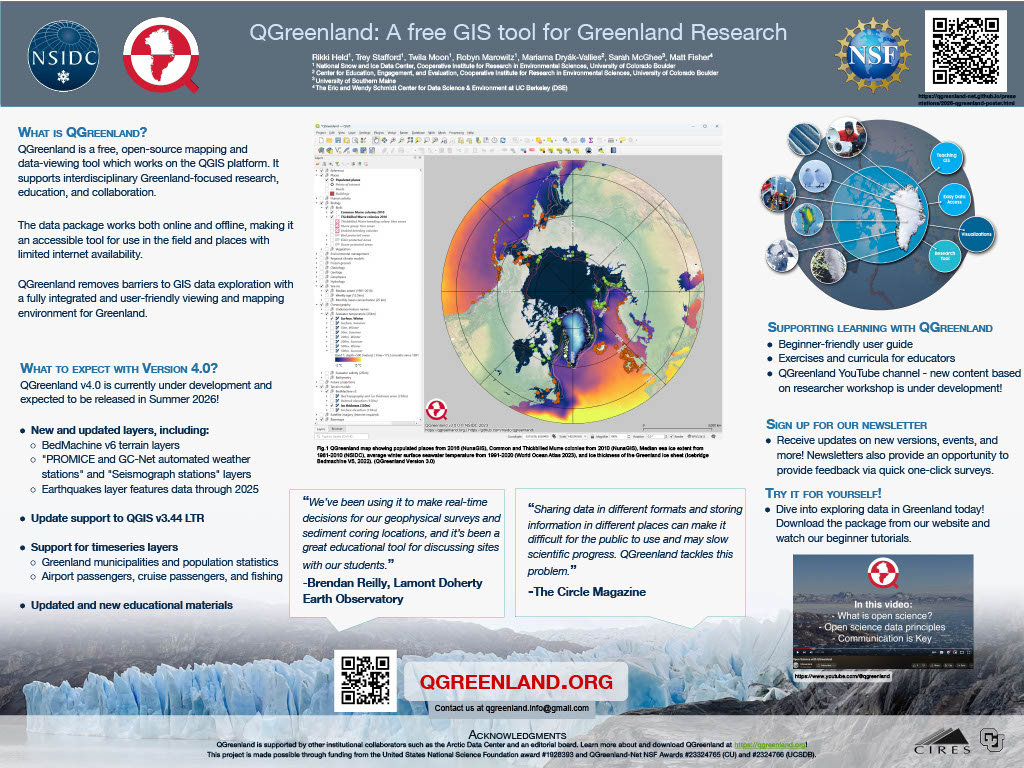
Trey Stafford, Rikki Held, Twila Moon, Robyn Marowitz, Mariama Dryák-Vallies, Sarah McGhee, Matt Fisher
QGreenland: A free GIS tool for Greenland Research
"QGreenland is a free GIS data package for QGIS focused Greenland that was originally inspired by a similar package for Antarctic: Quantarctica. Our project built on Quantarctica's successes and caters to a diverse audience of researchers, students, and the general public who are interested in Greenland research. The development of QGreenland is driven by feedback from our users and international collaborators who help us decide what data should be included and how it should be represented. This poster highlights the upcoming QGreenland v4, which will include new and updated layers, improved support for QGIS v3.44 LTR, support for timeseries layers, and updated educational materials.
Exploring new data layers and figuring out how to support timeseries layers for v4 has been quite the adventure! We hope that the researchers and educators who plan field work, share maps and geospatial datasets, develop proposals and visuals, and teach about Greenland and GIS with QGreenland will benefit from v4 and have many adventures of their own!"
Best Overall:
Lauren Lipuma